Saturday, June 23, 2012
Sunday, June 3, 2012
Saturday, November 5, 2011
Conserving What and For Whom?
The use of land is a contentious issue. The debate often involves what should take precedence in determining the use of land with more than 12 per cent of the surface land under protected areas ( According to the World Conservation Monitoring Center). While the trade-off between the claims of indigenous people and the claims for non-human species are unclear, the protection of the natural environment has made displacement and compensation-based resettlement a taken-for-granted strategy in developing countries. Studies show that the practice of conservation through displacement adversely affects people’s welfare, and particularly that of economically marginalized people.
Nepal has almost 23% of its total surface area for conservation. The large-scale displacements continue to represent the major conservation strategy whereas the indigenous communities face social exclusion which has been historically rooted in the land settlement policies. The backdrop of this socio-economic upheaval involved a displaced indigenous group, the Rana Tharus in the western-most districts of Kanchanpur in Nepal. Rana community experienced a large-scale displacement due to the expansion of the Shuklaphanta Wildlife Reserve in 2001. Consequently, the Nepalese government carried out a land-based resettlement scheme on the principle that all displaced families should be given cultivable land, which they previously lost due to the extension of the wildlife reserve.
![]() |
| Shukalphanta Wildlife Reserve |
We conducted an empirical study based on an 18-month long anthropological survey of the displaced Rana Tharus community administered between 2004 and 2006. Our research findings indicate that the conservation-led displacement made the Rana Tharus community vulnerable to further impoverishment. First, the history of social exclusion rooted in the land reform and land settlement policies deprived Ranas of proper land rights. Second, the inadequate land-based compensation policy both in terms of the size and the quality of land has compounded only social injustice. We further assessed the welfare impact of this land compensation policy.
On one hand, displaced Ranas suffered from landlessness, inadequate agricultural produce and food insecurity. This led only to further impoverishment. On the other, displacement led to serious household partitions in the wake of impoverishment. This negatively affected the patrilineal kinship relationships which have traditionally been a major source of informal security for Rana households, both economically and socially. Also, the poor harvest in the resettled communities and growing conflicts over the control of limited land deteriorated the traditional patron-client system of permanent agricultural workers and lowered the kinship ties. Overall, the erosion of informal safety nets resulted into a vicious cycle of poverty for the poor Rana Tharus community and made them vulnerable to destitution within a period of three to five years.
This is taken from my ongoing research with my colleague Christie Lam (Assistant Professor of Anthropology, Osaka University).
Monday, August 8, 2011
A day trip to Nara, Japan
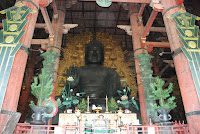
| Todai-ji Temple |
| The Great Buddha |
For visitors to Japan, Nara contains a very nice slice of the land of the rising sun. Not so famous like Kyoto, Tokyo, Hiroshima or Osaka - Nara is known for its historical importance, the Great Buddha site, and last but not the least the sake (rice wine). It was the first permanent capital of Japan (before Kyoto and Tokyo) and is located near Kyoto and Osaka (takes less than an hour to reach there).
The main attraction of Nara is the todai-ji temple, which houses the great Buddha statue (the Diabutsu) which was created out of iron. All the non-samurai had to give up their swords to help create this huge statue of Buddha, amazing huh! According to the lonely travel guide book, this rivals Mt. Fuji and Kyoto’s golden pavilion as the single most impressive sight of Japan! Also, the Todai-ji temple is the largest wooden building in the world.
| Sake barrels |
You will also come across free roaming deer walking all over the city. Sometimes they get aggressive but that is only when they see food. You can feed rice cakes (from local vendors) to them, just be a little careful as they would almost knock you over to get the rice cakes. One good thing, the ones with antlers have them filed.
| Touka-e Festival in Nara |
We stayed late to watch the elegant summer night illumination events (in Japanese Touka-e festival). Since its beginning in 1999, it has attracted a large number of tourists and converted them into ardent fan of Nara. It is a fascinating sight, more than 20,000 candles illuminate Nara's famous world heritage sites. Each candle is set in a small plastic cup, and lit by hand, one by one.
Finally, sake. If you come to Nara, dont forget to try the sake. The history of Japanese sake started in Nara, and since then Nara has been producing the finest sake in Japan, indeed!
Saturday, August 6, 2011
Nakamuraya Curry Traces back to the Indian Revolutionaries in Japan
| Nakamuraya Instant Curry Pack |
If you are in Tokyo you must visit Nakamuraya bakery (restaurant). It has branches all over Tokyo specializing in Indian curry. The first of its kind in Japan, Japanese-style Indian curry has been sold since 1927 as one of the reputed products of Nakamuraya. They also sell pre-cooked instant curry that only needs to be heated and served at home. It is indeed a popular product in Japan and you can get them in almost every convenient or departmental store across Japan. Why did Nakamuraya, which was originally a bakery start selling Indian curry? And continues to be obsessed with Indian curry for nearly a century?
It was an Indian, Rash Behari Bose, who introduced Indian curry to Nakamuraya. He was a revolutionary leader fighting the British in India. The post war generations of Japanese may not know the great Indian revolutionaries like Rash Behari Bose or Subhash Chandra Bose, but they were well-known figures in Japan in the years before the Second World War. Rash Behari Bose was one of the key organizers of the bomb attack on Lord Hardringe and the Gadar conspiracy at Lahore. In 1915, he fled to Japan to avoid a certain death sentence and had no inkling of the harsh destiny in store for him, and that he would never step on Indian soil again. He was instrumental in persuading the Japanese authorities to secure foreign help for India’s liberation from the clutches of the imperialist power. He did the spadework for the creation of the Indian National Army (INA) before passing the baton on to Subhash Chandra Bose in 1943.
![]() | ||
| Rash Behari Bose and his wife Toshiko* |
Going back to curry, Rash Behari Bose was not only a leading extremist Indian freedom fighter but was also a chef. Soon after his arrival in Japan, the Foreign Ministry under pressure from the British Embassy issued an extradition order against him. It was Aizo Soma, owner of the Nakamuraya in Shinjuku (Tokyo) who rescued him and skillfully hid him in a studio near the restaurant. He was confined there for months for security reasons. Fortunately, there was a kitchen in the studio where he could cook and the only leisure he had was to prepare his meals. He requested the maids to buy the ingredients and spices. Watching him, the maids and the owner of the restaurant gradually learnt to cook Indian food, however it took almost twelve years for Nakamuraya to launch Indian curry later in 1927.
![]() |
| With Tagore at Nakamuraya* |
Bose fell in love with Aizo’s daughter and got married to Toshiko. He had two children from her. In July 1923, Bose became a citizen of Japan and registered his wife and children under the ‘Bose family’. In the same year, Nakamuraya was recognized as a public limited company. Bose along with the children became one of the leading shareholders and was also appointed as the director of the Nakamuraya. Traditionally, Japanese curries were made in the Anglo-Indian manner. In order to turn Japanese eyes to the ‘real taste of India’ he devoted himself to the launch of actual Indian curry. Popularizing Indian curry among the Japanese was also a part of his anti-colonial struggle, by trying to win back India’s food culture from British hands. And since then Rash Behari Bose came to be widely known as ‘Bose of Nakamuraya’.
Notes
I am grateful to Corinne Boyle (Professor of Economics, Konan University) for helping me find the fascinating story about Indian freedom fighters hidden in Nakamuraya’s Indian curry.
*pictures are taken from the Nakamuraya restaurent website @
Saturday, July 23, 2011
The International Monetary Fund needs a new head !
Read what Raghuram Rajan thinks (Professor, University of Chicago Booth School of Business and Former Chief Economist at the IMF) !
(From Fault Lines)
(From Fault Lines)
Kiyomizu-dera Temple, Kyoto
If you decide to visit only one temple (out of more than 13,000) in Kyoto, I would highly recommend Kiyomizu-dera, the largest and the most famous temple in Kyoto. It was founded in 798 AD but the present temple complex was rebuilt in 1633.
It became a UNESCO World Heritage Site in 1994. Kiyomizu-dera occupies an excellent location on a steep hill in eastern Kyoto. The quaint street leading up to the front gate of the temple is called "Teapot Lane" and is lined with handicraft, restaurants, souvenir shops and sweet shops.
The main hall of Kiyomizu-dera is is notable for its vast veranda, supported by 139 wooden pillars (each 49 feet high), which juts out over the hillside and offers breathtaking views of the city. The views and temple grounds are especially lovely during the spring and autumn. The expression "to jump off the porch at Kiyomizu" is the Japanese equivalent of the English expression "to take the plunge." This refers to an Edo period tradition that held that, if one were to survive jumping from the terrace, one's wish would be granted. 234 jumps were recorded in the Edo period and of those, 85.4% survived.
Beneath the main hall is the Otowa-no-taki ("Sound of Feathers") waterfall, where three channels of water drop into a pond. This waterfall is counted among the ten most famous pure water sites in Japan and it is the source of Kiyomizu-dera's name (mizu means "water").
Visitors to the temple collect the water from the falls in metal cups and drink it for health, longetivity, and wisdom, respectively. Traditionally, one should only choose two; being greedy and drinking from all three can bring misfortune!
Subscribe to:
Posts (Atom)